Most companies redesign their website every two or three years. New colors, new hero image, new "About Us" video. Same broken structure underneath. And that's the actual problem nobody talks about.
Here's the reality: website structure isn't a design decision. It's an SEO decision, a user behavior decision, and increasingly, an AI visibility decision. Get it wrong, and no amount of good website design will save you.
What Website Structure Actually Means
Website structure is the way your pages are organized, linked, and grouped so both humans and search engines can find, understand, and rank them. It includes three separate layers that most teams accidentally treat as one:
- Navigation structure: what visitors see in your menu
- URL structure: how your pages are labeled and nested
- Internal linking structure: how pages connect to and support each other
Confusing these three is the single biggest reason company websites underperform in search, even when the website design itself looks premium.
The Real Reason Most Company Websites Are Structured Wrong
Here's a fact most brands don't know: your website structure is probably copied from your org chart, not from how people actually search.
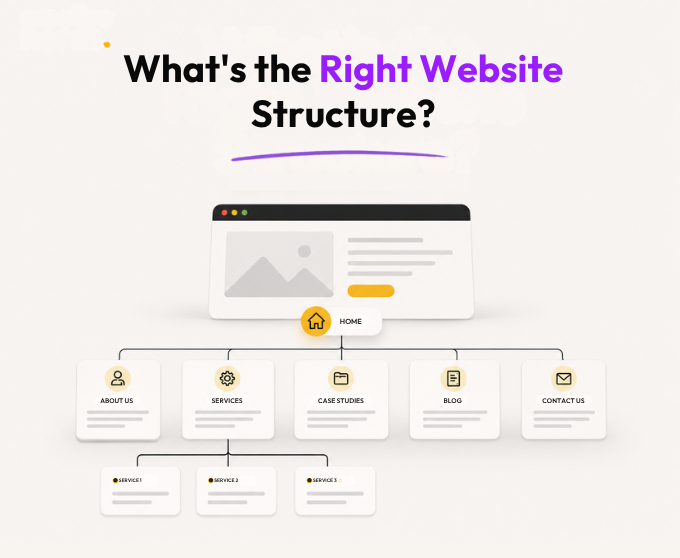
Companies build menus like "Services, About, Team, Blog, Contact" because that's how the business sees itself internally. But nobody searches "your company plus About Us." They search for the problem they have. A structure built around departments instead of search intent creates a site that makes sense to your CEO and nobody else.
This is also why "add more pages" is bad advice. More pages without a clear hierarchy just dilutes authority across your site instead of concentrating it where it matters most.
How to Structure a Website for SEO, Actually
If you're wondering how to structure a website for SEO instead of just for looks, here's the model that actually works right now:
- 1. Build topic clusters, not category lists. Group content around core themes with a pillar page, supported by related pages linking back to it. This tells search engines and AI answer engines exactly what you're an authority on.
- 2. Keep important pages within three clicks. Google's John Mueller has said this isn't about counting slashes in a URL, but he's acknowledged that how easy content is to find affects how much relative weight Google gives it, and that crawl resources are limited on large sites. In practice, it's common to find B2B sites where the highest-value pages sit four or five clicks deep, buried under service categories nobody actually searches by name.
- 3. Let URLs reflect hierarchy. A URL like /services/seo/website-structure tells search engines exactly where a page sits in your site's logic. A URL like /page-47 tells them nothing at all.
- 4. Internal links are votes, but not equal ones. Google's Reasonable Surfer model weighs links by position and context, not just how many exist on a page, so a link inside your main content passes more authority than one buried in a footer or a long list. Structure should direct that weight toward the pages that actually drive revenue, not spread it evenly across everything.
Flat vs Siloed Architecture: Which One Wins
Small websites usually do fine with a flat structure: homepage, then everything one level below it. But once a site grows past a few dozen pages, flat structure collapses under its own weight. When unrelated pages all sit at the same level with no grouping, search engines have a harder time working out what you're actually an expert in.
Siloed structure, where content is grouped into clear topic clusters with internal links reinforcing each cluster, wins for any company producing regular content. It's simply how search engines evaluate topical authority.
The AEO Angle Nobody Is Structuring For Yet
Here's where most agencies stop. Search isn't just Google's blue links anymore. Tools like ChatGPT Search, Perplexity, and Google's AI Overviews are search-augmented: they run a live query, pull a set of candidate pages, then extract and cite whichever ones are structured cleanly enough to lift a direct answer from. Each engine weighs sources a bit differently too, so structure that works for one doesn't guarantee visibility on another.
To structure a website for AEO, not just SEO:
- Answer the core question in the first two sentences of every page, before the storytelling starts
- Use clear H2 headers phrased as actual questions people ask
- Keep one clear answer per section instead of burying it inside long paragraphs
- Add FAQ blocks with direct, quotable answers
The Redesign Trap: How Companies Kill Their Own Rankings
This is the costliest mistake companies make. A website redesign, done without mapping old URLs to new ones through proper redirects, can wipe out years of rankings almost overnight. Agencies that track this consistently report organic traffic losses in the 30 to 60 percent range in the months after a redesign, not because the new design was bad, but because the URLs changed and nothing told search engines where the old pages went. It wasn't the new design that failed. It was the structure underneath that got rebuilt without a plan.
If you're redesigning, structure comes before visuals, every single time.
A Quick Structure Audit You Can Run Today
Ask three questions about your current site:
- Can a stranger reach your most important page in three clicks or less?
- Do your URLs describe where a page actually lives in your site's logic?
- If someone searched your homepage's core question, could an AI answer engine pull a direct answer straight from your content?
If you answered no to any of these, your website structure needs work before your next design refresh does.
Conclusion
Good website design gets attention. Good website structure gets rankings, traffic, and AI visibility that actually compounds over time. One is decoration. The other is infrastructure, and infrastructure is what keeps working long after the trend fades.
At Creative Nerds, we build both. If your website isn't showing up where it should, let's fix the structure before you spend another rupee on a redesign that won't deliver lasting results. Reach out to us at +91 91670 08137.